
What Optrak does
Electric and Alternative Fuel Vehicles
Optimally planning electric and mixed-fuel fleets requires more than just a maximum range figure. Optrak works out an EV's real range from the physics of each route and is capable of planning mid-route charging. Diesel, electric, HVO, CNG and LNG vehicles are planned together in the same plan with per-route costing and CO₂ tracking.
Last updated: 2026-08-11
Real Range, Not a Number on a Spec Sheet
Optrak works out an electric vehicle’s energy use for each round from the physics of the journey — mass, gradient, drive cycle, start time, and weather — using the consumption framework developed at Cambridge’s Centre for Sustainable Road Freight. That is what captures the factor-of-two spread a single range figure hides: a laden vehicle up a long climb in winter is a very different round from the same distance empty on a mild day, and only one of them might fit the battery. Planning against the real figure is what turns “we think it’ll be fine” into a decision you can defend.
Charging as Part of the Round
For rounds that go beyond a single charge, Optrak plans the charging stop as part of the route rather than leaving it to the driver to work out. The stop is placed where it fits the round, scheduled around the legally required break, and sized to the top-up actually needed. That is what turns a round that “an EV can’t do” into one it can do with one planned stop — and it is why longer regional work doesn’t have to stay on diesel by default.
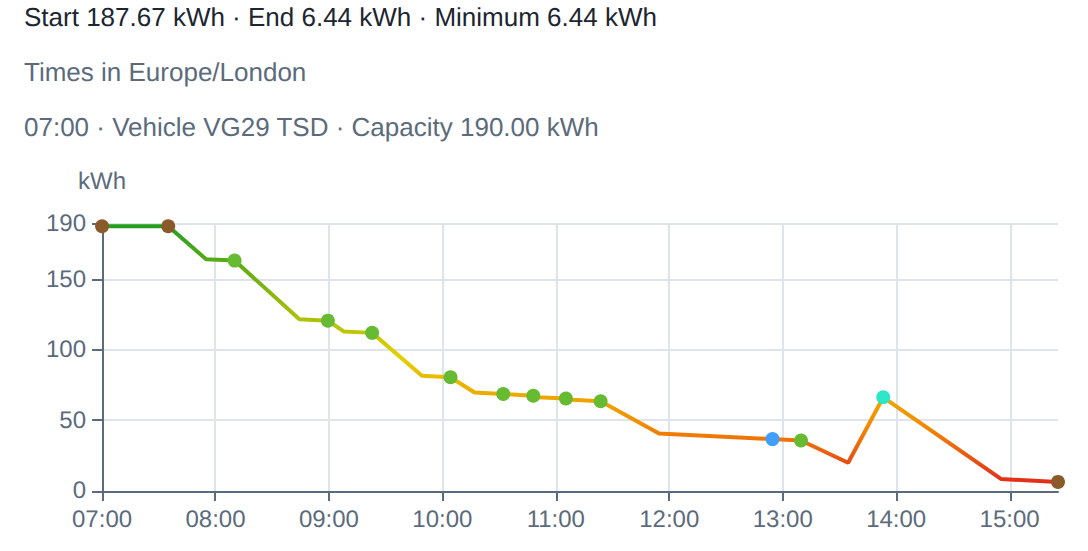
One lorry’s battery through a day of nine deliveries. The 19-minute stop at a public charger puts in enough to finish the round, and the lorry gets back with 6 kWh left.
Running a Mixed Fleet
Through the transition a fleet is rarely all one thing. Optrak plans diesel, electric, HVO, CNG and LNG vehicles together, each with its own cost and CO₂, and produces per-round figures that add up across the day. HVO is the easiest near-term step, because it goes into a diesel truck as it stands; gas vehicles are a different purchase but a real part of some fleets already. Whatever the mix, a plan can carry all of it at once and the balance can shift year on year as more vehicles arrive and charging improves — and the CO₂ output gives a credible, checkable basis for emissions reporting rather than an estimate.
Planning the Switch, Not Guessing It
Deciding which vehicles to buy and what charging to build is a bigger question than any single day’s plan, and Optrak answers it with the same engine. Its EV transition planning sorts your real rounds by how electric-ready they are and sizes the fleet and charging that follow. The e-HGV transition page walks through that decision from the operator’s side.
Related
- EV consumption modelling — real range from the physics of the round
- In-route charging — charging stops planned inside the route
- EV transition planning — sizing the fleet and the charging
- The e-HGV transition — the switch to electric, from the operator’s side
- Congestion and journey times — planning against the road as it really is
Frequently Asked Questions
What does ‘multi-fuel’ mean here?
Running more than one kind of vehicle in the same operation and planning them together — diesel, electric, HVO, CNG and LNG. Optrak costs and schedules each on its own terms in a single plan, rather than treating the fleet as if every vehicle were the same. Each vehicle carries its own fuel or energy figures and its own CO₂, so the mix is a property of the fleet you describe rather than something the planner has to work around.
How do you know an electric vehicle can actually do a round?
By working out its energy use from the physics of the round — load, gradient, drive cycle, start time, and weather — rather than trusting a single headline range. Real range varies by roughly a factor of two across those conditions, so a round a spec sheet says is fine can strand a vehicle in winter under full load. Planning against the real figure is what makes the answer trustworthy.
What about rounds that are too long for a single charge?
Optrak can place a charging stop inside the route — scheduled around the driver’s break, sized to the top-up the round needs — so a round that exceeds single-charge range still runs on an electric vehicle rather than defaulting to diesel.
Is this only relevant to heavy trucks?
No. The same modelling applies to vans and rigids as much as to HGVs — anywhere real range and charging decide which rounds an electric vehicle can take on. The heavy end is simply where the range swings and the charging questions are sharpest.
See Optrak on Your Own Routes
Book a demo and we'll model your fleet, depots and constraints — and show the savings on real data.