What Optrak does
Integrated Loading
Optrak checks whether a vehicle can actually be loaded — and unloaded in the right order — as part of building the route, not as a separate step afterwards. Weight, volume, compartments, and delivery sequence are tested while the plan is made, so the routes it gives you physically work.
Last updated: 2026-08-11
Why Loading and Routing Can’t Be Separated
Loading and routing are the same problem seen from two ends. The sequence of drops decides how the vehicle has to be packed; how the vehicle can be packed decides which sequences are even possible. Split them and you get plans that are individually reasonable and jointly unworkable:
- a round that exceeds the vehicle on weight while there is still space, or fills the volume while it is still under weight;
- goods that need separate compartments or temperature zones loaded as if the body were one box;
- a delivery order that would require unloading half the vehicle at every stop.
Deciding the route without testing the load is how those plans get made. Testing the load as the route is built is how they are avoided.
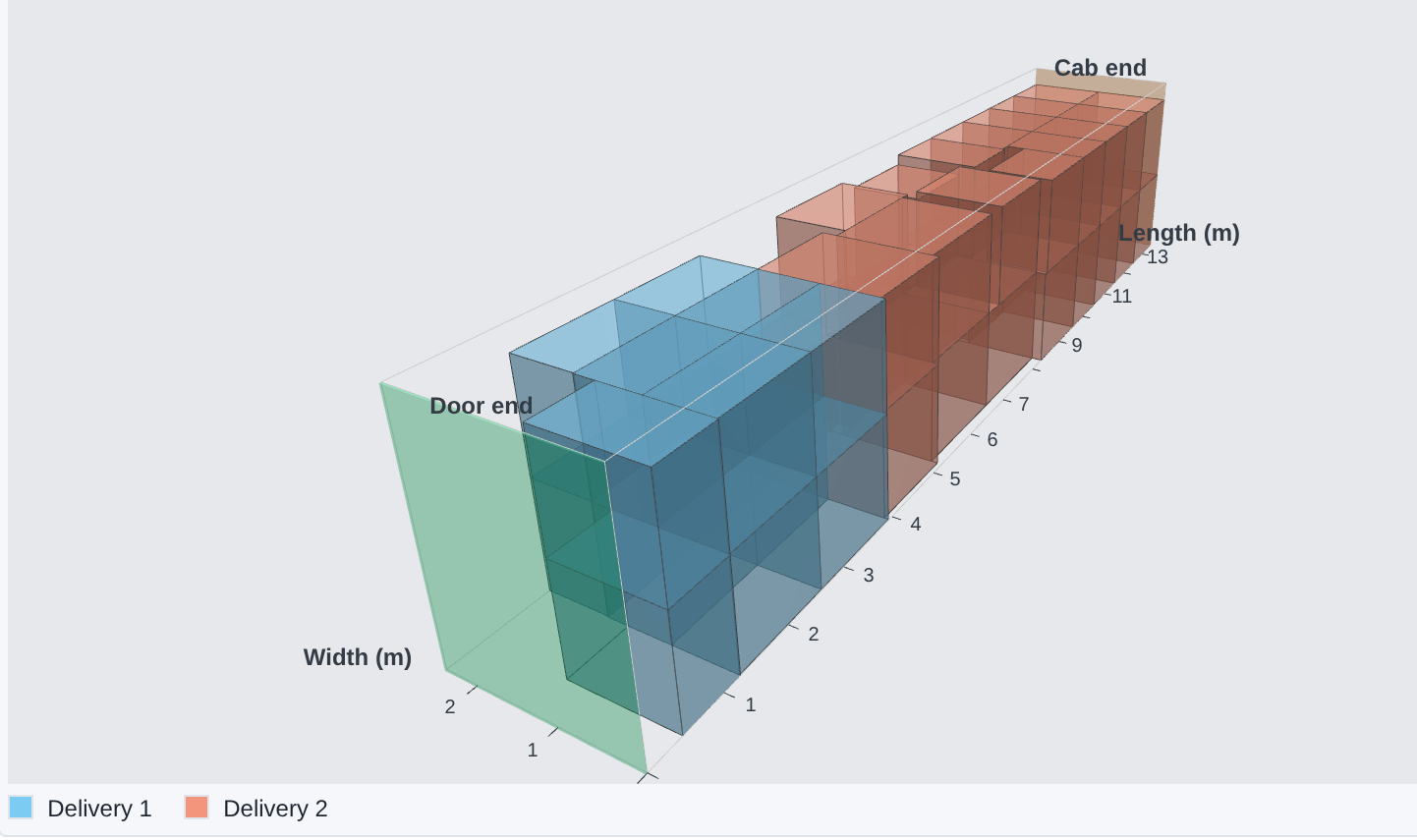
A lorry’s load as it leaves the depot, for a journey with two deliveries. The first delivery’s pallets (blue) are at the door end and the second’s (orange) at the cab end, so each delivery comes off without moving the other.
Checked Inside the Plan, Not Bolted On Afterwards
Optrak evaluates load feasibility during route construction. As it considers adding a drop to a round, it asks not only “does this make the route shorter?” but “can this vehicle still be loaded for this round, and unloaded in order?” A round that fails that test is never offered as a plan. This is what integrated means here: the loading check is one of the rules the optimiser keeps, in the same loop as everything else — not a second opinion from a tool that ran later and might disagree.
Modelled at the Level Your Operation Needs
Loading matters differently in different operations, so Optrak models it to the depth each one needs — from straightforward weight-and-volume checks through to 2D and 3D placement where the shape of the load genuinely decides feasibility. The fleet and equipment side of the data model carries the compartments, bulkheads, and vehicle dimensions this draws on, so a mixed fleet is planned vehicle by vehicle rather than against a lowest-common-denominator body.
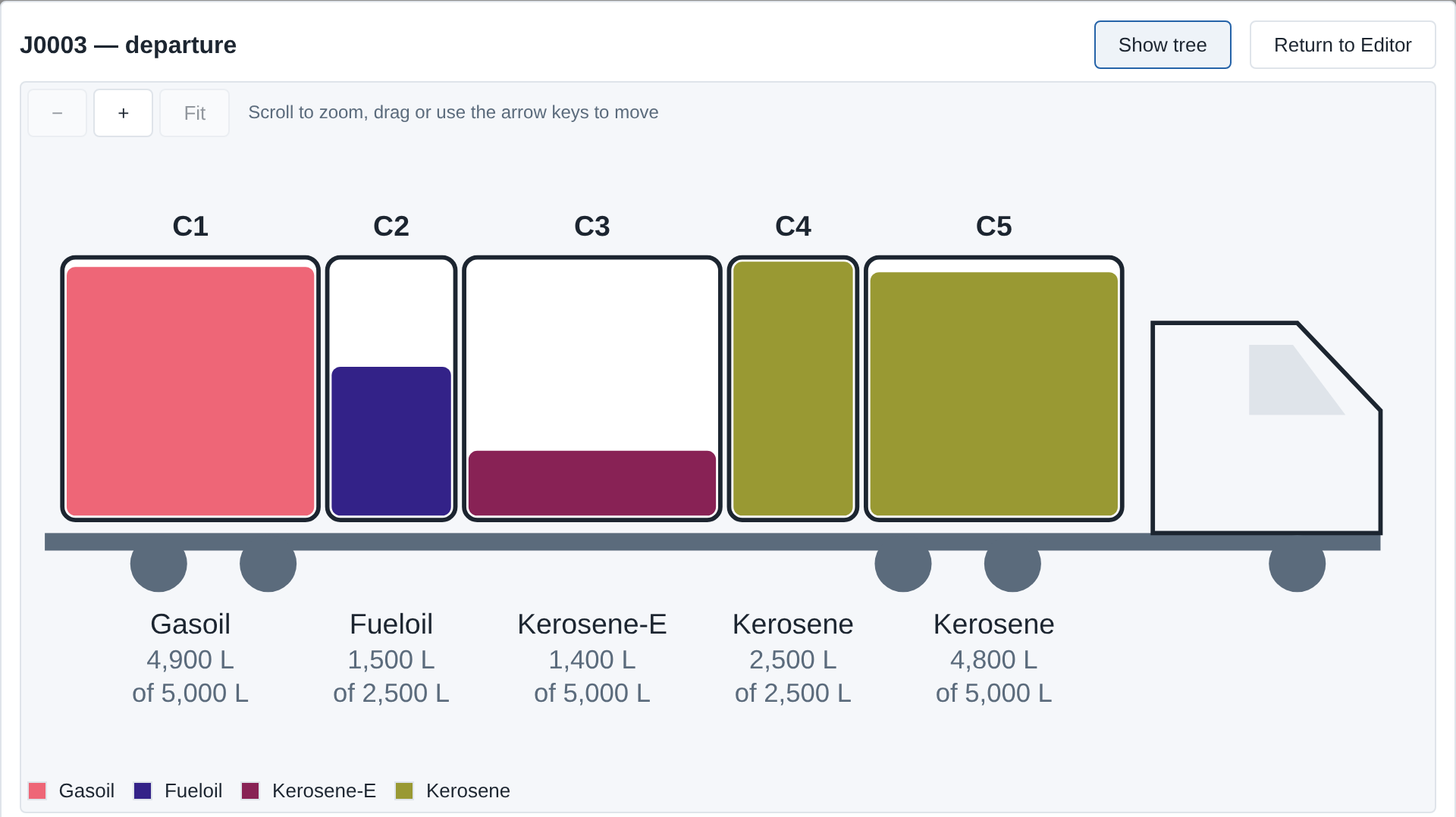
A five-compartment tanker as it leaves the depot: four products, one to a compartment. The plan has to fit each delivery to compartments, not just to the tanker’s total capacity.
Related
- Loading models — how Optrak judges whether a load is workable
- Fleet and resources — vehicles, compartments, and equipment
- Orders, products, and shipments — what actually has to be carried
- The Optrak data model — loading as a first-class input, not a bolt-on
Frequently Asked Questions
Isn’t loading the driver’s problem, not the planner’s?
Only if the plan handed to the driver is loadable in the first place. If routing ignores whether the goods fit and come off in the right order, the driver inherits an impossible load and has to re-jig it on the bay — or the round quietly can’t be done as planned. Checking loadability while the route is built means the sequence the driver gets is one that works.
What is the difference between a 3D load builder and integrated loading?
A standalone load builder packs a fixed list of items into a vehicle after the route has already been decided. Integrated loading turns that around: Optrak tests load feasibility as part of choosing the route, so it never commits to a round the vehicle can’t actually carry. The check is inside the plan, not a separate stage that can disagree with it.
Can it handle multi-compartment or temperature-separated loads?
Yes. Optrak models compartments, moveable bulkheads, and temperature zones, so a chilled-and-ambient vehicle or a multi-compartment tanker is planned against what it can really hold, not a single number for the whole body.
Does it understand the order things have to come off?
It does. A load that fits but is stacked in the wrong order is as much a failure as one that doesn’t fit — the last drop can’t be buried behind the first. Optrak accounts for delivery sequence when it judges whether a load is workable, so the plan respects how the vehicle is actually unloaded.
See Optrak on Your Own Routes
Book a demo and we'll model your fleet, depots and constraints — and show the savings on real data.