Industry
Multi-Temperature Distribution
Optrak plans multi-temperature distribution for convenience stores, food service, and supermarkets — moveable-bulkhead trailers, mixed cages and pallets, loading checked inside the route optimiser, and trailer swaps modelled as first-class resource moves.
Last updated: 2026-08-11
Multi-temperature distribution puts frozen, chilled, and ambient goods on the same vehicle, separated into compartments by moveable bulkheads. It is how convenience stores, food-service operators, and supermarkets get a full temperature range to a single site in one delivery rather than sending a separate vehicle for each regime.
The planning difficulty is that the vehicle’s capacity is not a single number. A moveable bulkhead means the split between frozen, chilled, and ambient changes from one round to the next, the load is a mix of roll-cages and pallets that have to sit alongside each other on the floor, and the order they come off matters at every drop. A planner that models the trailer as “so many pallets” will produce routes that don’t load — and the failure is only exposed at the warehouse when goods fail to fit, or at the kerb when the driver can’t access them to unload.
Three Sectors, One Planning Shape
The vehicles and drop profiles differ by sector, but the loading problem underneath is the same.
Convenience stores and food service typically run on rigid vehicles — the refrigerated body is fixed to the cab. Rounds are many small drops across an urban or regional area, the load is mixed cages and pallets across two or three temperature zones, and loading has to be complete and correct before the vehicle leaves the depot. Sequence matters: most rear-door vehicles unload last-in, first-out, so the build order has to match the delivery order.
Supermarkets, particularly medium and outlet-format stores, run on articulated tractor-trailers with fewer, larger drops — and trailer swaps at the distribution centre, because loading takes too long for a driver to wait for (covered in detail below).
Common to all three: a moveable bulkhead that reconfigures the temperature split trip to trip, a mix of roll-cages and pallets rather than a single handling unit, and frequently several temperature regimes destined for the same site in one delivery.
Loading a Multi-Temperature Trailer
Because stacking is restricted in a temperature-controlled trailer, this is a 2D floor-plan problem: fit the cages and pallets alongside each other on the floor, keep the trailer balanced side to side, reserve space for handling, and respect the bulkhead positions. Optrak’s load optimisation runs this check inside the route optimiser, on every candidate move, so a route whose load won’t physically fit never reaches the plan.
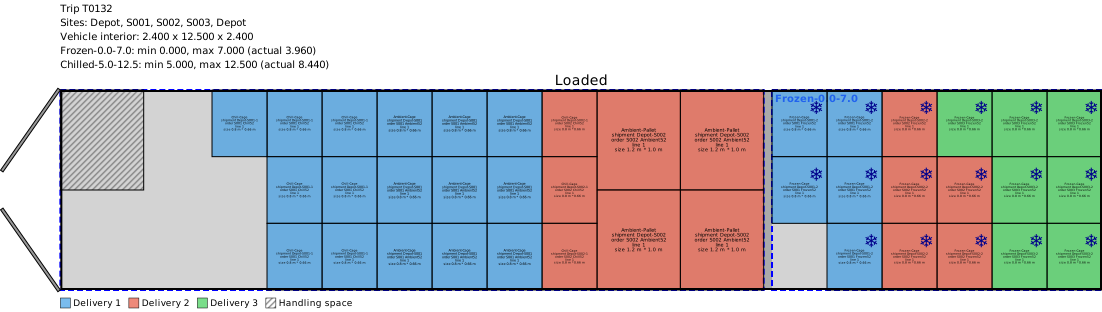
Dual-compartment trailer. A custom loading rule reserves a pallet-sized space next to the rear door. Delivery 1 (blue) is roll-cages; the chilled and ambient cages come off first so the frozen goods behind them can be reached.
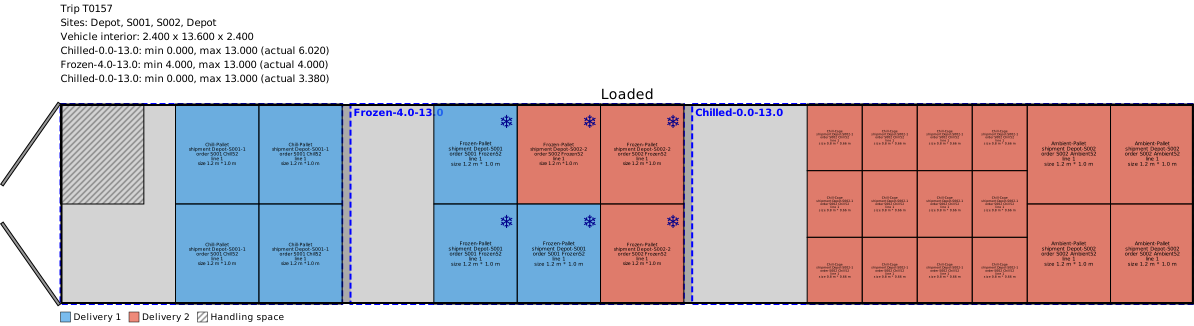
Tri-compartment trailer. A chilled-frozen-chilled arrangement with the larger Delivery 2 items furthest from the door
The bulkhead position is the variable that makes this harder than ordinary palletised work. Frozen capacity isn’t a fixed property of the trailer — it depends on where the bulkhead is set for the day’s mix, so the loader sizes each compartment to the orders rather than assuming a standard split. The load is also recomputed at the end of each visit, not just at the depot, so a layout that’s fine when the trailer leaves but goes out of balance after the second drop is rejected while the route is being built, not discovered on the road.
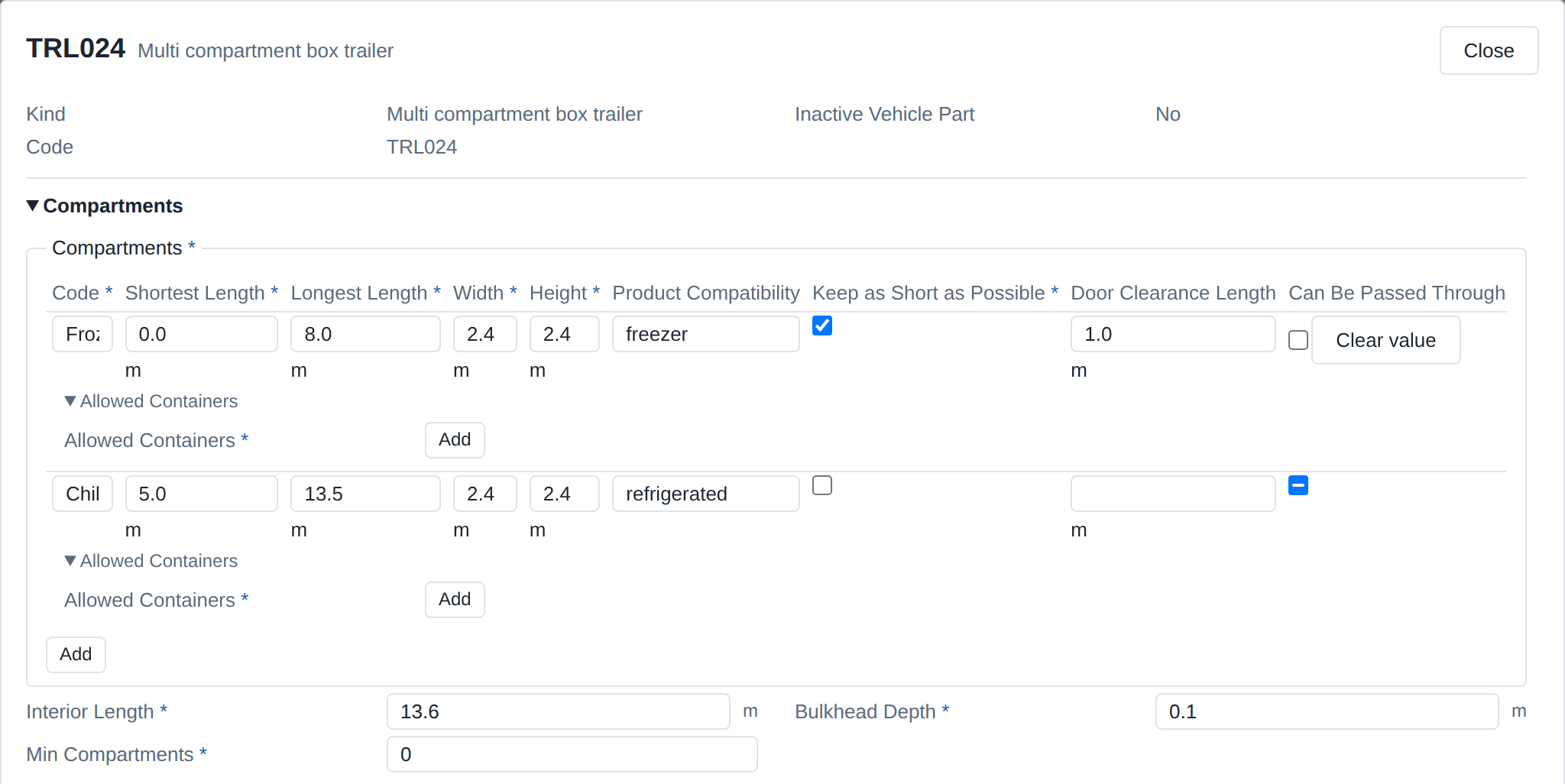
How a trailer with a moveable bulkhead is set up. The frozen section can be up to 8 m and the chilled section up to 13.5 m, in a 13.6 m trailer.
Trailer Swaps
A trailer swap is when a tractor unhitches one trailer and hitches another mid-shift. In supermarket operations the swap itself is forced by loading time: filling a multi-temperature trailer with the day’s cages and pallets takes far longer than a driver can sit and wait for, so a driver back at the distribution centre drops the empty and takes a trailer that was loaded while they were out. The expensive, hours-limited resources — the tractor and the driver — never wait for a load; the cheaper resource, the trailer, absorbs the wait. And the reload is planned too: a dropped trailer is not available for another round until the plan has allowed time to load it.
Because the swap happens anyway, it is also the moment to change trailer length. A full-length trailer carries the most cages, and the larger stores have the yard space and loading bays to take one. The smaller-format and urban stores don’t — tight streets, shared yards or on-street loading bays, a door a long trailer cannot be worked to. So the rounds Optrak has modelled send one tractor and driver out with the full-length trailer to the stores that can take it, then back to the distribution centre and on with a shorter urban trailer for the tight-access drops. Access decides the trailer, and the trailer decides the capacity.
This is impossible to plan if driver, tractor, and trailer are collapsed into one resource. Loading is committed to a trailer; driving is committed to a tractor and driver; the two meet at swap points fixed in time and place. Optrak models them as independent resources on a resource scheduling graph, so trailers can be pre-loaded and handed between tractors and drivers, and the compatibility rules that matter in practice — which products go on which trailer, which tractor-trailer pairings are legal, livery matching for 3PL fleets — are respected at the swap.
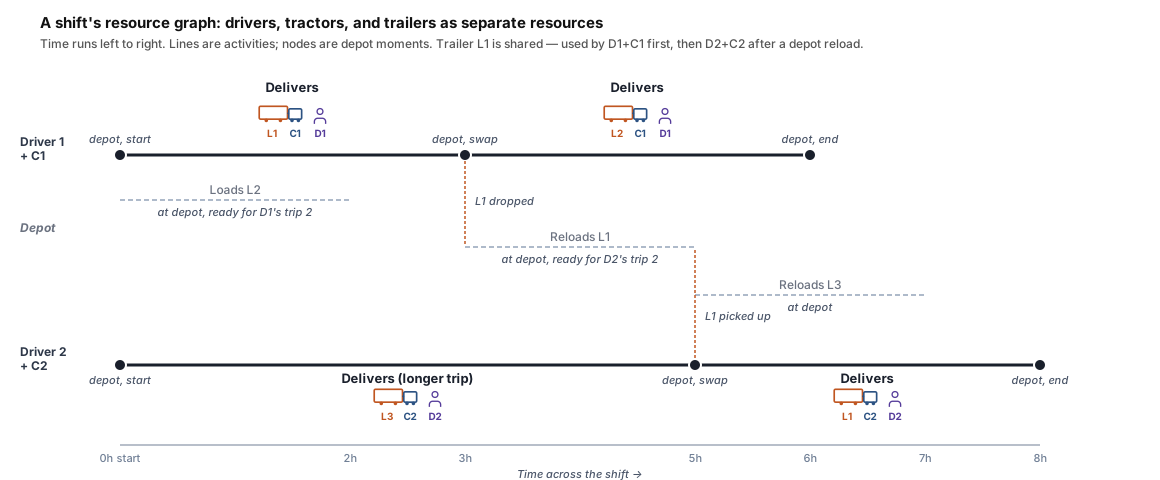
Trailer L1 is loaded once and used by two different drivers across the shift; the tractors and drivers stay productive while trailers are loaded and unloaded out of the critical path.
See fleet and resources for how the resource scheduling graph handles cross-shift use, multi-driver vehicles, and tractor-trailer reassignment.
How Optrak Handles It
Two architectural choices do the work:
- Loading is checked inside the optimisation loop. Every route modification triggers the 2D load feasibility check before the move can be accepted, so the optimiser cannot output a multi-temperature route whose cages and pallets don’t actually fit. This is different from the common route-then-load pipeline, where loading is fitted to a route already chosen — the difference matters most exactly when load is the binding constraint, which on a mixed-temperature trailer it usually is.
- Tractor, trailer, and driver are first-class, independently schedulable resources. That is what makes trailer swaps, pre-loading, and mid-shift trailer-type changes planable rather than worked around by hand.
For a planning system that only models capacity as weight-and-volume and ties a driver to a fixed vehicle, multi-temperature distribution is a stream of manual fix-ups: the planner re-sizes compartments by eye, checks loads by hand, and schedules swaps on a whiteboard. Putting the loading geometry and the resource structure into the model is what removes that rework.
Related
- Load optimisation — the 2D, 3D, and bulk loaders in detail
- Fleet and resources — tractors, trailers, drivers, and trailer swaps
- The Optrak data model — how loading and resources feed the optimiser
Frequently Asked Questions
What is multi-temperature distribution?
Multi-temperature distribution is the delivery of frozen, chilled, and ambient goods on the same vehicle, separated into compartments by moveable bulkheads. It lets an operator get a full temperature range to a single site in one delivery rather than running a separate vehicle per temperature regime. It is the standard model for convenience-store, food-service, and supermarket distribution.
How does Optrak handle a moveable bulkhead?
The bulkhead position is a planning variable, not a fixed wall. Optrak’s 2D loader sizes each temperature compartment to the day’s order mix and checks that the cages and pallets actually fit on the trailer floor, balanced side to side and in a sequence the driver can unload. Because the split changes trip to trip, frozen capacity on one route is not the same as the frozen capacity on the next — the loader recomputes it each time per route, rather than assuming a fixed compartment size. The placement of the bulkhead can be determined using a fully flexible positioning, or as a best choice for a set of possible fixed positions or mounting points.
Can Optrak plan trailer swaps?
Yes. In supermarket operations the swap is forced by loading time — a returning driver drops the empty trailer and takes one loaded while they were out, rather than waiting — and it is also the moment to change trailer length: full-length for the stores that can take one, a shorter urban trailer where access rules the long one out. Optrak treats the tractor, the trailer, and the driver as separate, independently schedulable resources, and holds a dropped trailer out of use until there has been time to reload it — none of which a planner that collapses driver-plus-vehicle into a single resource can represent. See fleet and resources for more details.
How is convenience-store distribution different from supermarket distribution here?
Convenience-store and supermarket operations differ mostly in their vehicle type and drop profile. Convenience and food-service routes typically run on rigid vehicles with the refrigerated body fixed to the cab, many small drops, and loading that must finish before the vehicle leaves. Medium and outlet-format supermarket work runs on articulated tractor-trailers with fewer, larger drops and trailer swaps at the distribution centre. The loading problem — mixed cages and pallets across temperature compartments — is common to both; Optrak is able to plan both using the same model.
Can one site receive frozen, chilled, and ambient in a single delivery?
Yes, that is the purpose of a multi-temperature vehicle. Products are assigned to compatible compartments during the load building stage; as the optimiser constructs these into a sequence to create routes, it keeps the assignment consistent so the right goods are reachable at each stop. Several products being delivered to the same site across different compartments are accommodated with the same loading plan.
Do warehouse staff get a loading diagram for a multi-temperature trailer?
Yes. Optrak produces a floor-plan loading diagram for every planned trip, showing each compartment, where each cage and pallet goes, and the order to load them so the unloading sequence works at the kerb (a first-in, last-out sequence typically). The diagram comes directly from the route plan, so the layout the planner optimised is the layout the warehouse receives.
See Optrak on Your Own Routes
Book a demo and we'll model your fleet, depots and constraints — and show the savings on real data.