Industry
Bulk Multi-Compartment Distribution
Optrak plans bulk multi-compartment distribution for petroleum, fuels, and chemicals — compartmented tankers with product-pair cleaning and pump sequencing, ADR and terminal-training constraints, 3PL livery rules, and multi-day order selection that mixes urgent and forward orders in a single-day plan.
Last updated: 2026-08-14
Bulk multi-compartment distribution moves several products on one vehicle: a compartmented tanker, each compartment carrying a single grade, pumped off at the customer’s site. It is how petroleum, fuels, and chemicals are delivered. What looks like a routing problem is really four problems at once: which product goes in which compartment, in what pumping sequence, with which qualified driver, from which terminal — and which of this week’s orders should go on a vehicle today at all.
A routing engine that treats the tanker as a single volume gets all four wrong. It will fill a vehicle that can’t legally carry that product mix, sequence drops that contaminate a pump, assign a driver without the right terminal training, or send a half-empty tanker out today when tomorrow’s run would have been full. The cost shows up as contaminated product, failed deliveries, and pence per litre that never comes down.
Loading, Cleaning, and Pump Sequencing
The loading rules are where bulk distribution is unforgiving. A compartment holds residue of its last product, so every product-to-product transition has a cost — none, a drain, a flush, or a full wash — and pumps and hoses carry their own contamination and sequencing constraints. Optrak’s bulk load optimisation encodes this as a cost-aware cleaning matrix (by product or, for lubricants with many grades, by product family), honours permanent product-to-compartment rules such as a dedicated AdBlue compartment, supports metered and unmetered compartments, and sequences pumps so incompatible grades never share one.
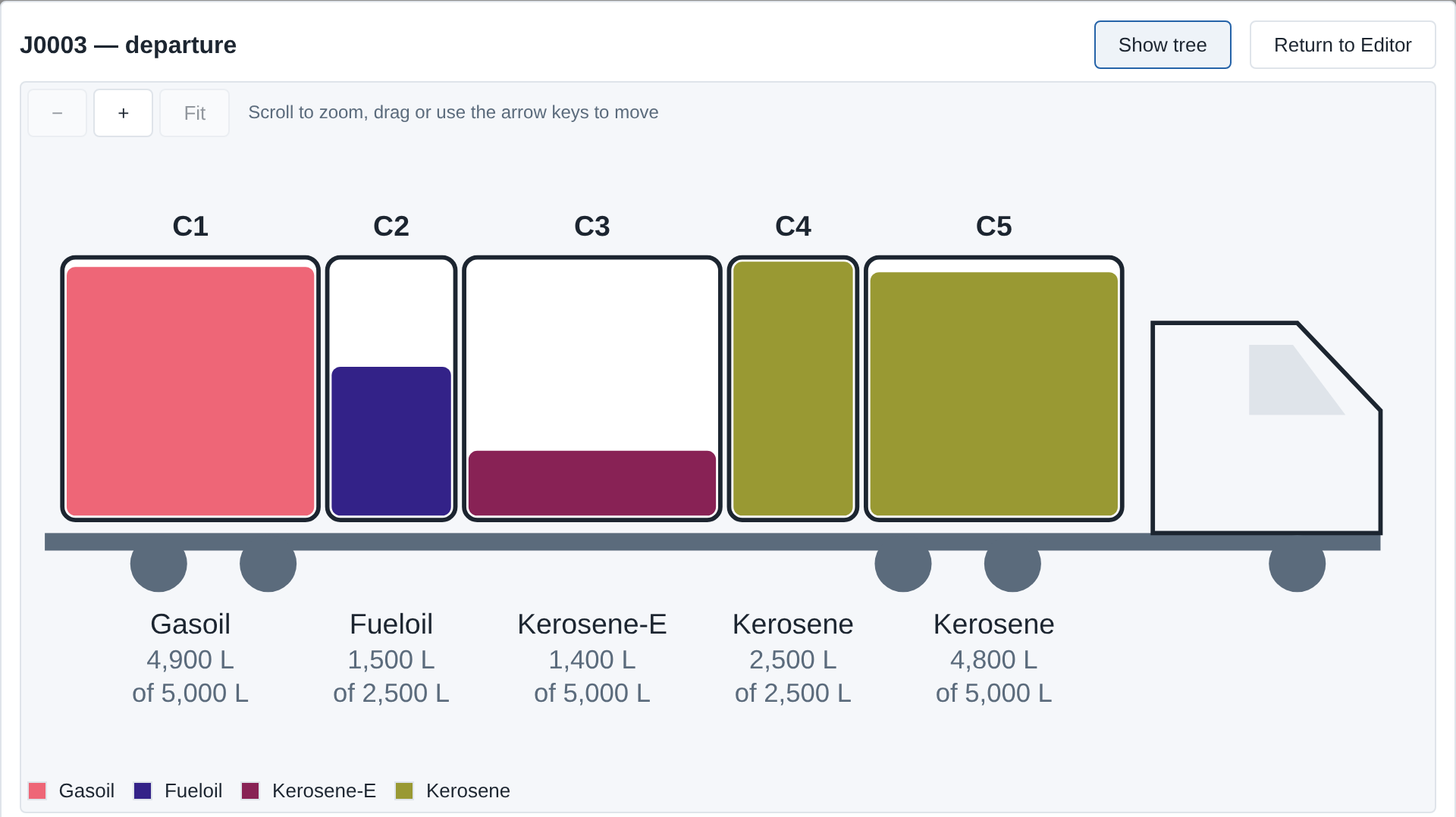
A five-compartment tanker as it leaves the depot: four products, one to a compartment, and two compartments only part full. The full cleaning matrix and pump-sequencing detail — including drain, flush, and wash actions — is on the load optimisation page.
The point that matters here is the same architectural one as everywhere in Optrak: these checks run inside the route optimiser, on every candidate move, so a route whose load would contaminate a compartment or a pump is rejected while it’s being built — not discovered at the loading rack.
A Multi-Day Horizon in a Single-Day Plan
Bulk orders don’t all need delivering today. They arrive with due dates spread across days, each inside its own SLA and time window. The planner still builds one day’s routes — but the orders worth putting on those routes are chosen from a multi-day horizon, not just today’s due list.
Optrak models urgency as a delivery priority. Urgent orders carry a higher cost of non-delivery, so the optimiser serves them first. Orders due later carry a lower priority, so they’re included only when they earn their place — filling spare compartment capacity on a tanker already heading into that region, or deferred to a fuller, more efficient run another day. The scheduler’s instinct — is it better to send a vehicle into London today, or tomorrow with greater utilisation? — becomes a decision the optimiser makes across the whole order book rather than one order at a time.
This is order selection, not just sequencing. The set of orders on the plan is itself an output, chosen to keep urgent commitments while lifting vehicle and compartment utilisation across the days ahead.
Drivers, Terminals, and Livery
Bulk petroleum is as much a resource problem as a loading one. Drivers carry qualifications that act as hard compatibility rules: ADR certification for dangerous goods, terminal training — often a day per oil terminal — and product-specific training covering spillage and emergency procedures. Sites add their own requirements: refinery inductions, security vetting, access limits that force a particular vehicle type.
For 3PL petroleum operators running several oil-company contracts from shared resources, it goes further. Tractor, trailer, and driver are independent resources, each with compatibility rules: livery matching (a tractor in one client’s livery can’t pull another client’s trailer; neutral livery pairs with any), per-client terminal and product training, and per-client paperwork. A model that collapses driver, tractor, and trailer into one resource can’t represent any of it; Optrak keeps them separate on a resource scheduling graph.
Because loading and preparation instructions come straight from the plan, tankers can be loaded ahead of the shift — the driver collects a ready vehicle and goes, keeping loading time out of the driving day and easing Working Time Directive pressure.
How Optrak Handles It
The capability rests on choices made elsewhere in the model and applied to this industry:
- Bulk loading inside the optimisation loop — compartment assignment, the cleaning matrix, and pump sequencing are checked on every route move, so contamination-unsafe plans can’t be produced.
- Order selection across a multi-day horizon — urgency expressed as delivery priority, so urgent and forward orders share a plan and utilisation rises without missing commitments.
- Drivers, vehicles, and sites as independent resources — ADR, terminal and product training, access rules, and 3PL livery handled as compatibility constraints rather than worked around by hand.
Petroleum-specialist tools handle compartmented tankers with contamination rules, and general VRP and TMS products do not. Optrak’s distinction is doing the bulk loading inside an integrated optimiser that also reasons about the multi-day order book and the full driver, vehicle, and site resource structure.
Lubricants — A Special Case
Lubricants follow the same compartment-and-cleaning discipline but push it further: many more grades than a fuel operation carries, so the cleaning matrix works by product family rather than by individual product, and loads that mix bulk with packaged goods. The distinctive vehicle is the hybrid truck — a box truck fitted with pumping equipment, carrying intermediate bulk containers (IBCs) that are pumped off at the customer, with the same floor space available for drums or palletised packaged goods instead. Lubricants distribution covers the sector, including how Optrak plans hybrid vehicles and the benchmarked results at Fuchs Lubricants (UK).
Related
- Lubricants distribution — many grades, hybrid trucks, and the Fuchs case study
- Load optimisation — the bulk loader, cleaning matrix, and pump sequencing in detail
- Fleet and resources — drivers, tractors, trailers, and qualification rules
- Sites — terminal training, inductions, access, and site-vehicle compatibility
- The Optrak data model — how loading, resources, and orders feed one optimiser
Frequently Asked Questions
What makes bulk multi-compartment distribution harder to plan than general haulage?
The vehicle is a set of compartments, not a single hold, and what you can load into each one depends on what was in it last. Cross-product contamination is governed by cleaning rules, pumping has its own sequencing constraints, drivers need product, terminal, and ADR qualifications, and orders arrive with due dates spread across several days. None of that is visible to a routing engine that models a tanker as so many litres.
How does the multi-day horizon work — can I mix urgent and forward orders?
Yes. Optrak plans one day’s routes but looks across a multi-day horizon of outstanding orders. Urgent orders carry a higher delivery priority, so they’re served first; non-urgent orders due later can be pulled forward to fill spare compartment capacity on a tanker that’s already heading that way, or held back for a better-utilised run another day — all inside the customer’s SLA and time window. It’s the trade a scheduler makes by hand between sending a part-full vehicle into a region today and a full one tomorrow, done across the whole order book.
How does Optrak stop cross-product contamination?
Through the bulk load optimisation: a configurable cleaning matrix costs every product-to-product transition (no action, drain, flush, or full wash), permanent product-to-compartment rules pin dedicated compartments, and pump-sequencing constraints keep incompatible grades off the same pump. The optimiser respects all of this while it builds routes, so a plan that would contaminate a compartment or a pump is never produced.
How are ADR and driver or terminal training handled?
As compatibility constraints between drivers, vehicles, and sites. ADR certification, terminal-specific loading training (often one day per oil terminal), and product-specific spillage and emergency training are all qualifications a driver either has or hasn’t; Optrak only assigns work a qualified driver can legally and safely do. Sites can also require inductions or vetting. See fleet and resources and sites.
Can Optrak handle 3PL petroleum with several clients and separate liveries?
Yes. Tractor, trailer, and driver are independent resources with their own compatibility rules, so a tractor in one client’s livery can be barred from a trailer in another’s, neutral livery can pair with any client, and a customer site can require matching livery. Combined with per-client terminal and product training, this is how a 3PL running several oil-company contracts from shared resources is planned without collapsing into one combined entity.
Does the driver wait while the tanker is loaded?
Not if loading is planned ahead. Optrak produces compartment-by-compartment loading and preparation instructions from the route plan, so tankers can be loaded before the shift and the driver picks up a ready vehicle and leaves. That keeps loading time out of the driving day and reduces the bite of Working Time Directive limits.
See Optrak on Your Own Routes
Book a demo and we'll model your fleet, depots and constraints — and show the savings on real data.